A Free, Open Northern Hardwoods Tree Identification Course
Parker Hopkins
•
1 September 2026
•
9 mins
I have spent enough time staring at a tree from the wrong side of a ravine to know that tree identification guides tend to assume a fairly cooperative tree.
The leaf is supposed to be mature, intact, and within reach. The bark is supposed to look like the single bark photograph in the book. The fruit is supposed to be attached. It is apparently always summer. Nothing has been chewed, cankered, weathered, shaded, soaked by rain, or altered by 100 years of being a tree.
That is not usually how identifying trees works in the woods.
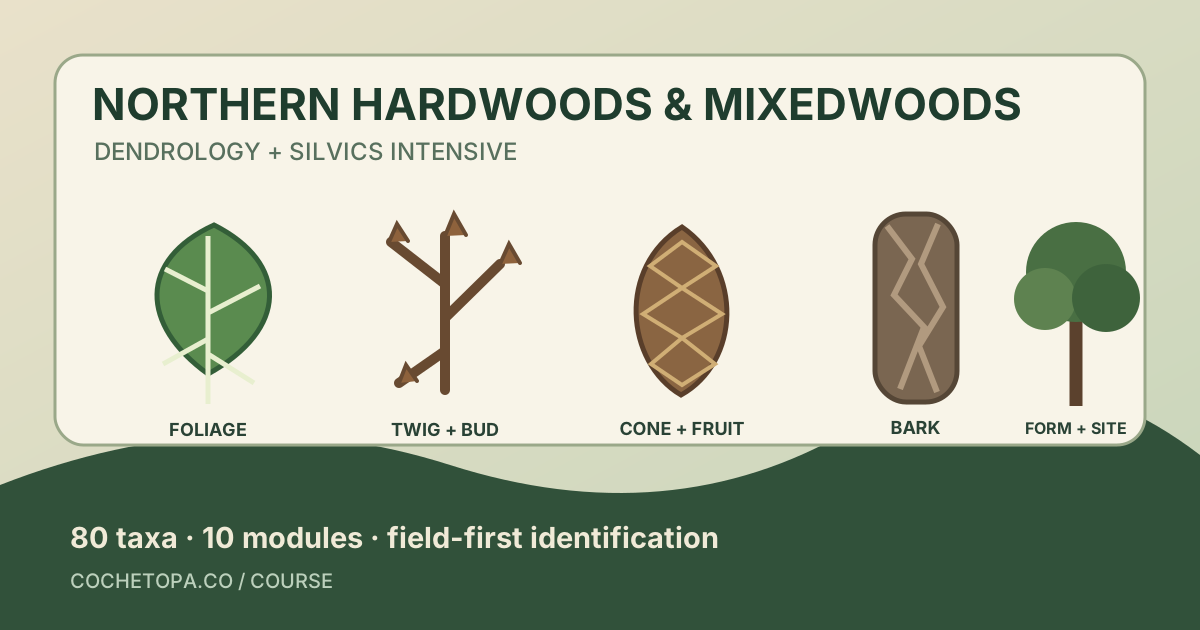
So I built the Northern Hardwoods & Mixedwoods Dendrology and Silvics Intensive, a free, self-paced course on the important trees of northern hardwood and mixedwood forests. It is open now on Cochetopa.
The course is intended to be useful for forestry students, field technicians, landowners, natural-resource professionals, arborists, serious naturalists, and anyone else who wants to become much harder to fool by a tree.
Free, open, and self-paced
There is no tuition, application, subscription, or paywall. The teaching material is open to explore.
If you want the course to remember your progress, grades, mastery record, and place across devices, the account process is deliberately small: enter an email address, then confirm the link sent to that email. That is it. There is no password to invent or remember. Optional encouragement emails are controlled by the learner and can remain off.
The course is organized as ten weeks, but those weeks are a sequence rather than a deadline. Ten weeks can mean ten serious weeks, a longer field-season project, or occasional work whenever you have the time. The assessments and cumulative retrieval stay demanding either way.
What part of the forest does it cover?
The center of gravity is the northern hardwood forest, but northern hardwoods do not stop neatly at the edge of one cover type.
The course follows the trees across Minnesota, Wisconsin, Michigan, the Great Lakes-St. Lawrence region of Ontario and southern Quebec, New York, New England, New Brunswick, the Allegheny Plateau of Pennsylvania, and the northern edge of New Jersey. It also reaches into the boreal transition, conifer-hardwood mixtures, lowlands, floodplains, oak-hardwood transitions, and Acadian forests that a field forester in this region is likely to encounter.
Regional abundance matters. Sugar maple, American beech, yellow birch, eastern hemlock, white pine, balsam fir, the major spruces, northern red oak, the ashes, and other characteristic trees get more repetition than peripheral species. The less common trees are included where they matter regionally or where they are realistic confusers.
The idea is to learn a species, not a photograph
The course covers 80 taxa and uses more than 1,000 documented teaching and practice photographs. Formal assessments draw from a separate examination pool.
That separation matters. Seeing the same picture of a sugar maple twelve times is a good way to learn one picture of a sugar maple. It is not a good way to become reliable in the field.
Instead, trees return in different forms and under different conditions:
- leaves and needles, including upper and lower surfaces, sun and shade foliage, seasonal material, and incomplete specimens;
- sapling, intermediate, mature, old, wet, shaded, damaged, diseased, and lichen-covered bark;
- buds, twigs, leaf scars, pith, pubescence, thorns, and persistent winter structures;
- samaras, acorns, nuts, drupes, pomes, capsules, cones, catkins, and seeds;
- crown architecture, branching, bole form, regeneration habit, site, and associated species; and
- disease, insects, injury, browse, weather, and growth forms that make an otherwise familiar tree look strange.
You will not always receive all of the evidence. Sometimes the correct answer is a species. Sometimes it is a genus or a species group. Sometimes the photograph simply does not support a defensible identification, and “insufficient evidence” is the right field call.
The difficult trees are placed next to one another
Many identification courses introduce similar trees on separate days and hope the differences remain obvious later. This course spends a lot of time making the alternatives collide.
That includes sugar, black, and Norway maple; white, green, and black ash; paper, heart-leaved, and gray birch; the native spruces and Norway spruce; red, jack, and Scots pine; the regional red-oak and white-oak groups; the elms; aspens and poplars; cherries; hickories; walnuts; hornbeam and hophornbeam; native compound-leaved trees and their invasive lookalikes; and quite a few other combinations.
The recurring questions are:
- What is it?
- What is the nearest plausible alternative?
- Which visible character separates them?
- What additional view would you request if you were not sure?
That last question is particularly useful in the field. A good forester is not someone who makes every identification instantly. A good forester knows which next piece of evidence is worth walking around the tree to find.
Silvics remains attached to the tree
Identification is the largest part of the course, but it is not the whole thing. Every principal species has a concise silvics capsule covering what a forester should carry mentally into the woods: shade tolerance, moisture and drainage, soil and climatic affinities, common associations, regeneration, vegetative reproduction, seed behavior, succession, disturbance response, growth and longevity, browse, important health agents, and management implications.
Scientific names are cumulative from the beginning. So are mistakes.
The course keeps a mastery record by species and evidence type and maintains an Error Ledger that distinguishes not knowing a tree from confusing two known species, missing the scientific name, getting the ecology wrong, or being much more confident than the evidence justified. Weak material comes back sooner. Strong material comes back at wider intervals.
What you should be able to do by the end
By the end of the course, a successful learner should be able to:
- identify the 80 required taxa rapidly from unfamiliar photographs or specimens when the evidence supports a species-level answer;
- identify important species independently from foliage, bark, dormant material, reproductive structures, whole-tree form, and ecological context;
- retrieve preferred common and accepted scientific names in both directions;
- distinguish the nearest realistic confusers using visible diagnostic characters;
- ask for the most useful additional view when the available specimen is incomplete;
- recognize when only genus, group, or insufficient evidence is defensible;
- recognize important age, disease, insect, injury, weather, browse, and growth-form variation without confusing host identity with condition diagnosis;
- apply practical silvics to site evaluation, regeneration, succession, disturbance, and management decisions; and
- transfer those skills across northern hardwood, Great Lakes-St. Lawrence, Acadian, Allegheny, boreal-transition, lowland, riparian, and oak-transition forests.
The ten-week path
The course begins with northern-hardwood anchors, expands through close hardwood confusers, and then moves into coniferous mixedwoods, boreal-transition forests, ashes and elms, lowlands, oaks, hickories, walnuts, Allegheny associates, Acadian forests, winter material, condition identification, and adversarial specimens.
Week 10 introduces little or no new material. It is a cumulative certification week with scientific-name and silvics examinations plus foliage-only, bark-only, reproductive, dormant, whole-tree, regional-context, and rapid mixed-evidence practicals.
For ordinary identification questions, entering either the preferred common name or the scientific name is enough to submit and receive identity credit. Dedicated nomenclature questions require the requested name. Optional confidence and field-reasoning fields are there when you want deeper calibration, but the interface does not require an essay for every tree.
The complete species list
The species are divided into three course tiers. Tier A trees receive the greatest repetition. Tier B trees are important regional species. Tier C contains planted, naturalized, invasive, peripheral, or especially useful comparison taxa.
Tier A - core mastery
- American basswood (Tilia americana)
- American beech (Fagus grandifolia)
- American elm (Ulmus americana)
- American hornbeam (Carpinus caroliniana)
- Balsam fir (Abies balsamea)
- Bigtooth aspen (Populus grandidentata)
- Black ash (Fraxinus nigra)
- Black cherry (Prunus serotina)
- Black spruce (Picea mariana)
- Eastern hemlock (Tsuga canadensis)
- Eastern hophornbeam (Ostrya virginiana)
- Eastern white pine (Pinus strobus)
- Green ash (Fraxinus pennsylvanica)
- Northern red oak (Quercus rubra)
- Northern white-cedar (Thuja occidentalis)
- Paper birch (Betula papyrifera)
- Quaking aspen (Populus tremuloides)
- Red maple (Acer rubrum)
- Red pine (Pinus resinosa)
- Red spruce (Picea rubens)
- Sugar maple (Acer saccharum)
- Tamarack (Larix laricina)
- White ash (Fraxinus americana)
- White oak (Quercus alba)
- White spruce (Picea glauca)
- Yellow birch (Betula alleghaniensis)
Tier B - regional mastery
- American mountain-ash (Sorbus americana)
- American sycamore (Platanus occidentalis)
- Atlantic white-cedar (Chamaecyparis thyoides)
- Balsam poplar (Populus balsamifera)
- Bitternut hickory (Carya cordiformis)
- Black maple (Acer nigrum)
- Black oak (Quercus velutina)
- Black walnut (Juglans nigra)
- Black willow (Salix nigra)
- Blackgum (Nyssa sylvatica)
- Boxelder (Acer negundo)
- Bur oak (Quercus macrocarpa)
- Butternut (Juglans cinerea)
- Chestnut oak (Quercus montana)
- Chokecherry (Prunus virginiana)
- Common hackberry (Celtis occidentalis)
- Cucumbertree (Magnolia acuminata)
- Eastern cottonwood (Populus deltoides)
- Eastern redcedar (Juniperus virginiana)
- Flowering dogwood (Cornus florida)
- Gray birch (Betula populifolia)
- Heart-leaved paper birch (Betula cordifolia)
- Jack pine (Pinus banksiana)
- Mockernut hickory (Carya tomentosa)
- Mountain maple (Acer spicatum)
- Northern pin oak (Quercus ellipsoidalis)
- Pagoda dogwood (Cornus alternifolia)
- Pignut hickory (Carya glabra)
- Pin cherry (Prunus pensylvanica)
- Pin oak (Quercus palustris)
- Pitch pine (Pinus rigida)
- River birch (Betula nigra)
- Rock elm (Ulmus thomasii)
- Sassafras (Sassafras albidum)
- Scarlet oak (Quercus coccinea)
- Shagbark hickory (Carya ovata)
- Showy mountain-ash (Sorbus decora)
- Silver maple (Acer saccharinum)
- Slippery elm (Ulmus rubra)
- Speckled alder (Alnus incana subsp. rugosa)
- Striped maple (Acer pensylvanicum)
- Swamp white oak (Quercus bicolor)
- Sweet birch (Betula lenta)
- Tuliptree (Liriodendron tulipifera)
Tier C - recognition and realistic confusers
- American chestnut (Castanea dentata)
- Black locust (Robinia pseudoacacia)
- European larch (Larix decidua)
- Norway maple (Acer platanoides)
- Norway spruce (Picea abies)
- Scots pine (Pinus sylvestris)
- Siberian elm (Ulmus pumila)
- Smooth serviceberry (Amelanchier laevis)
- Tree-of-heaven (Ailanthus altissima)
- White mulberry (Morus alba)
Start wherever you are
This is a serious course, but it is not meant to be exclusive. You do not need to arrive already knowing the vocabulary or carrying a perfect winter twig collection. You can begin with the first northern-hardwood anchors and build from there.
The goal is not to make every quiz feel easy. The goal is to make the trees increasingly difficult to mistake when you are actually standing among them.
Begin the free Northern Hardwoods & Mixedwoods course →
Like it? Share it!